BREAKING: Entanglement in the Trees got published in FGCS
Authors:
I.I. Birlica, A.B. Popa, B.C. Ciobanu, F. Pop, P.G. Popescu
Future Generation Computer Systems 184 (2026)
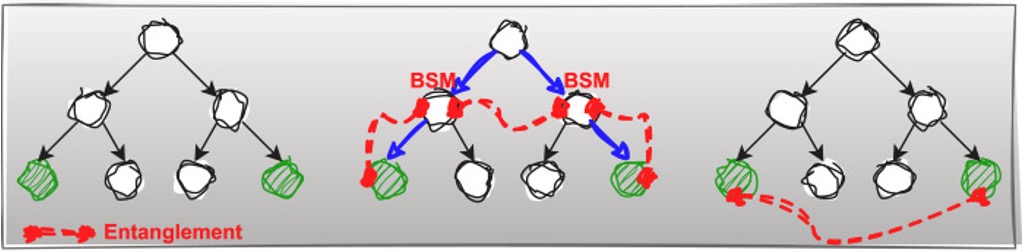
Quantum entanglement is the most important resource in quantum networks, with no classical equivalent, and therefore, efficient entanglement distribution plays a key role in quantum communications and technologies. Optimal distribution of entanglement in a general network is a known hard problem. In this paper we analyze entanglement distribution via entanglement swapping in tree topologies showing how the problem can be reduced to chordal graph coloring. Our proposed solutions are mathematically sound for any tree network, providing polynomial-time optimal scheduling for entanglement distribution. The binary tree topology requires only one Bell State Measurement device per node, i.e. minimal hardware configuration, so, providing an optimal polynomial-time entanglement distribution algorithm for this topology establishes a fundamental building block that can be extended to more general tree topologies with diverse hardware setups. Through numerical simulation, we present a comprehensive analysis of the requests distribution per timeslot, optimal number of timeslots, variance, and running time, in terms of tree size, request distance bias, and parametrized balance in the tree topology construction. A complete optimality and complexity analysis is also provided.
See more...
Authors:
A. Muşat, A. Tănăsescu and P.G. Popescu
Physical Review A, 113(2), 022215 (2026)
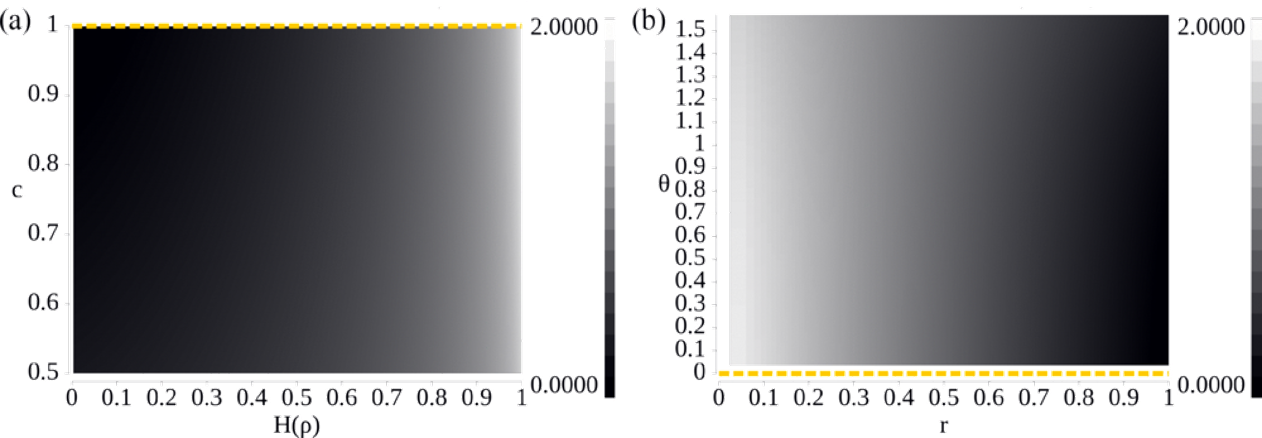
Entropic uncertainty relations have been a famed research topic for over 65 years with many applications and still many unknowns left. For example, even for single-qubit states, the optimal min-entropy uncertainty relation has only been found for pure states. In this paper we provide the optimal min-entropy uncertainty relation for mixed states of any purity for pairs of arbitrary qudit bases, marking a significant milestone in this journey. Moreover, our proof of optimality is constructive: for every base overlap and state purity we find an explicit example that saturates our bound.
See more...
Authors:
B.C. Ciobanu, T.A. Calafeteanu, A.B. Popa, R. Tătăroiu and P.G. Popescu
Nature Scientific Reports 15, 16459 (2025)
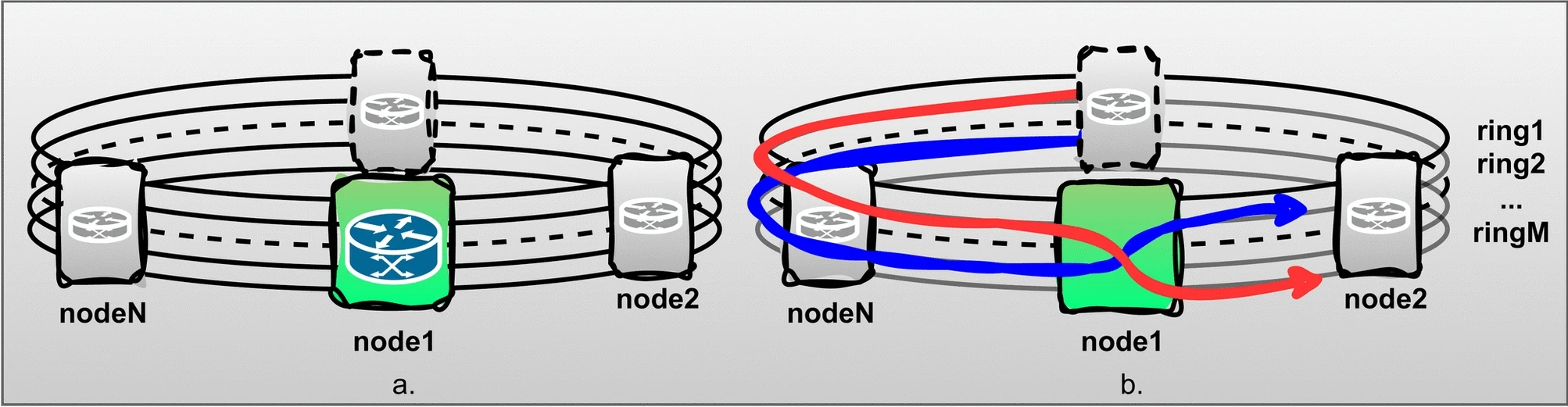
Entanglement distribution networks are essential for enabling secure, reliable, and sustained communication through the future Quantum Internet. Multi-ring network topologies offer improved scalability and redundancy, but also introduce additional routing complexity for the task of efficiently distributing entanglement. This paper solves the problem of optimal entanglement distribution in multi-ring quantum network topologies. Two separate multi-ring network configurations are analyzed, one where requests can only be routed within a single ring layer, and involves a less complex node setup, and one where requests may switch ring layers when passing through the network’s nodes, at the cost of additional complexity within the nodes themselves. We propose algorithms that solve the problem of entanglement distribution in terms of optimal time needed to satisfy a set of entanglement resupply requests with given network resources, as well as the problem of optimal resources in order to satisfy a set of entanglement resupply requests within a single entanglement transmission and measurement step. We provide a comprehensive analysis of the proposed algorithms through computer simulations, which indicate that the additional complexity of a network which allows switching between ring layers brings little benefit in terms of time to serve requests, but may reduce the number of resources needed to satisfy the entanglement distribution requests in a non-blocking manner.
See more...
Authors:
S.A. Catrina, R.A. Guţoiu, A. Tănăsescu and P.G. Popescu
EPJ Quantum Technology, 12(1), 83 (2025)
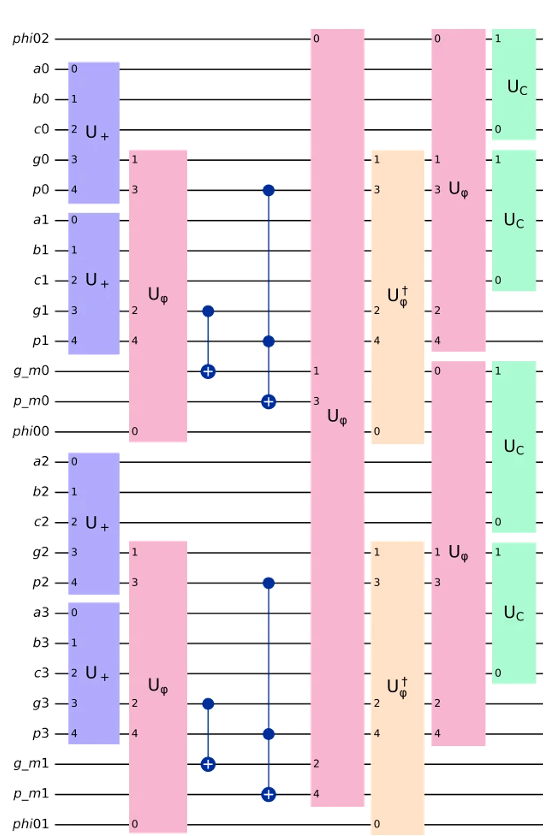
While adders are required for many classical and quantum algorithms, nowadays' single quantum computer implementations cannot handle the large qubit counts required in practical applications. Implementing a distributed approach is currently the only solution, but it poses the challenge of communication latency. This paper introduces a quantum distributed adder algorithm (QUDA) as a solution for many applications that require large qubit counts. QUDA offers a logarithmic number of instances of quantum data transfer for the addition of two numbers in comparison with existing solutions which are generally either based on ripple carry adders with a linear number of transmission rounds or attempt to distribute an existing monolithic circuit without specializing their techniques to adders. We include implementation details and the used testing methodology, showcasing the correctness and efficiency of the proposed algorithm.
See more...
Authors:
A.B. Popa, B.C. Ciobanu and P.G. Popescu
Quantum Reports, 7(1), 12 (2025)
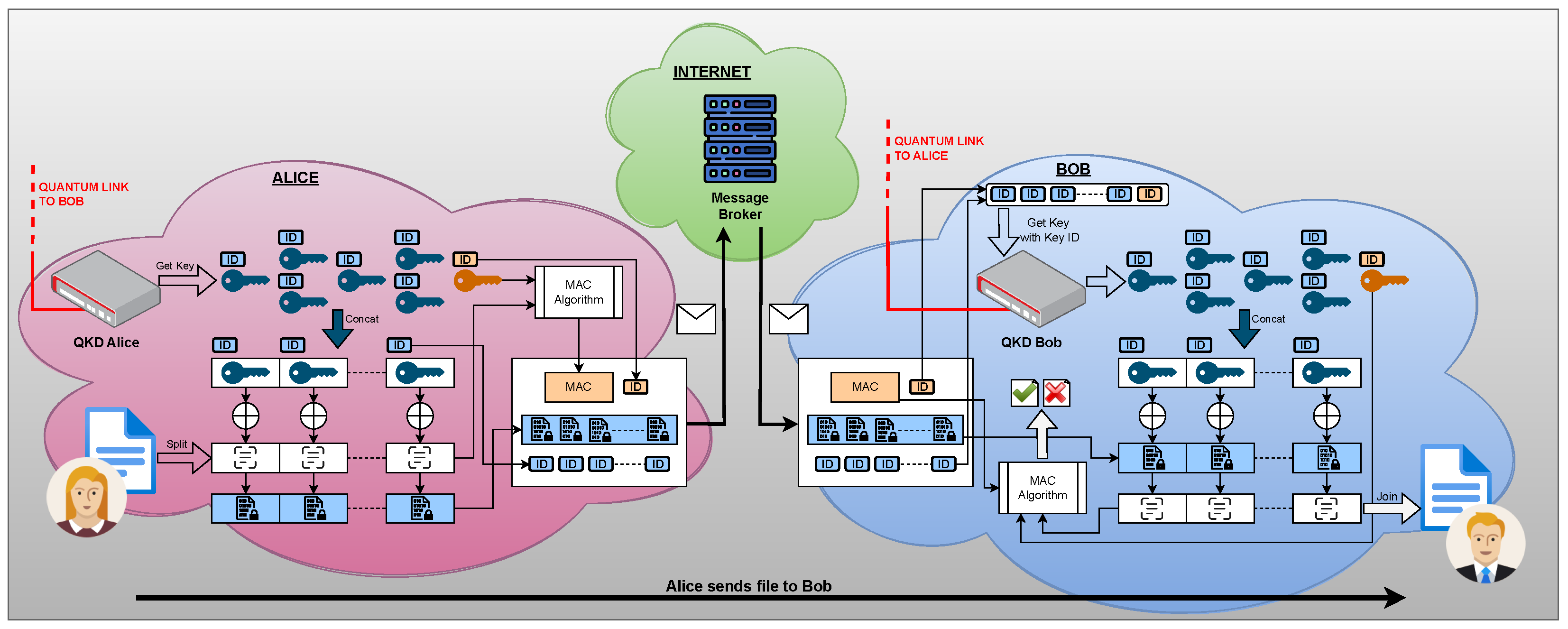
With the looming threat of quantum computers capable of breaking classical encryption and the uncertainty regarding the security of post-quantum encryption algorithms, some highly sensitive applications aim for the highest level of security in information transfer: unconditional security. In this work we present an architecture and a practical implementation of a user-friendly unconditionally secure file transfer client based on quantum key distribution and one time pad cipher. We test the implementation on the live QKD research infrastructure within POLITEHNICA Bucharest, thus proving the approach is feasible for real information transfer use-cases.
See more...
Authors:
R.A. Guţoiu, A. Tănăsescu and P.G. Popescu
Quantum Information Processing, 24(11), 373 (2025)
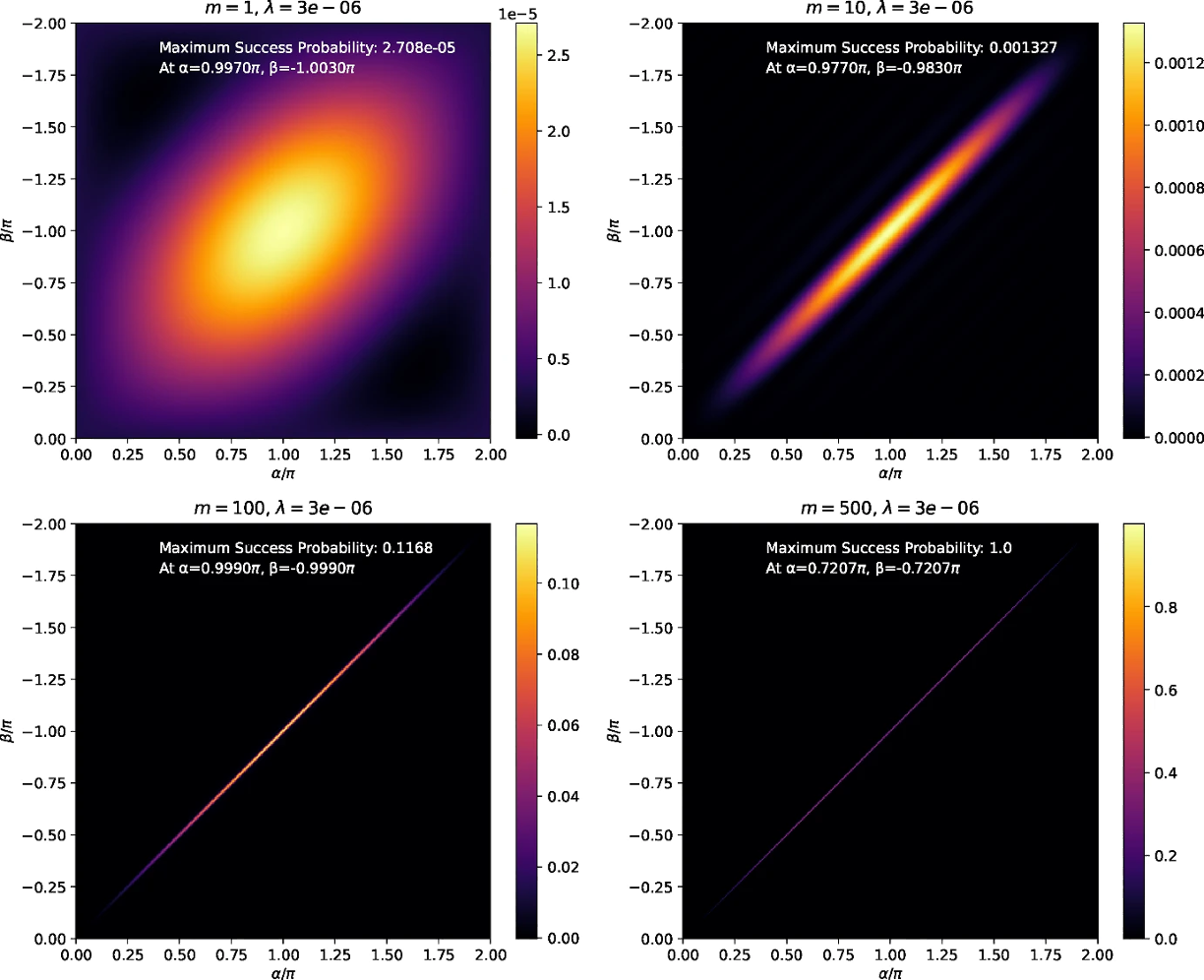
Many variations of Grover's algorithm attempt to improve iteration count using a technique known as phase matching, replacing Grover's phase-flip oracle with an-rotation oracle that cannot be simulated using only one Grover oracle call. Previously it was shown that phase matching can always achieve 100% success probability with an iteration count within one step from the Grover algorithm. In this paper, we show that this is actually the optimal iteration count, hence finding the first proof of the minimal number of queries to solve the search problem with a known number of solutions whether we use an-rotation or the Grover flip.
See more...
Authors:
A.B. Popa, B.C. Ciobanu, V. Iancu, F. Pop, and P.G. Popescu
Future Generation Computer Systems 158, 89-97 (2024)
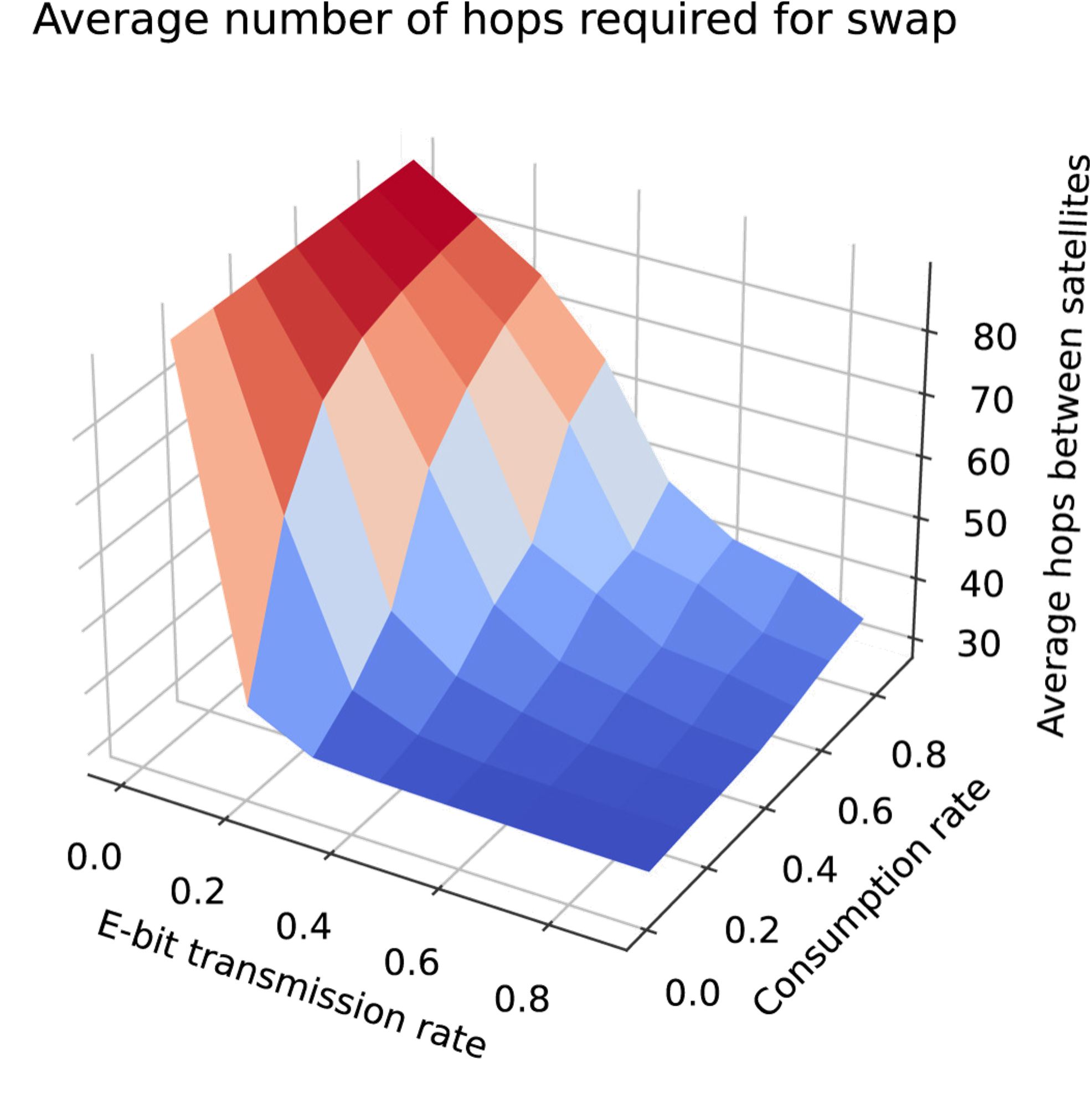
We propose a fast, satellite-based, on-demand entanglement resupply protocol which leverages entangled pairs exchanged in advance between satellites and ground stations. At the request time, the protocol does not require any quantum information exchange between ground and satellite, by performing the quantum entanglement swapping on satellite-level only, thus separating the particle exchange phase. In this work we analyzed different recent approaches on the topic of satellite-based entanglement resupply and our protocol improves existing works by minimizing fidelity loss due to environmental factors regardless of the distance between requesting ground stations.
See more...
Authors:
R.A. Guţoiu, A. Tănăsescu and P.G. Popescu
Quantum Information Processing, 23(10), 356 (2024)
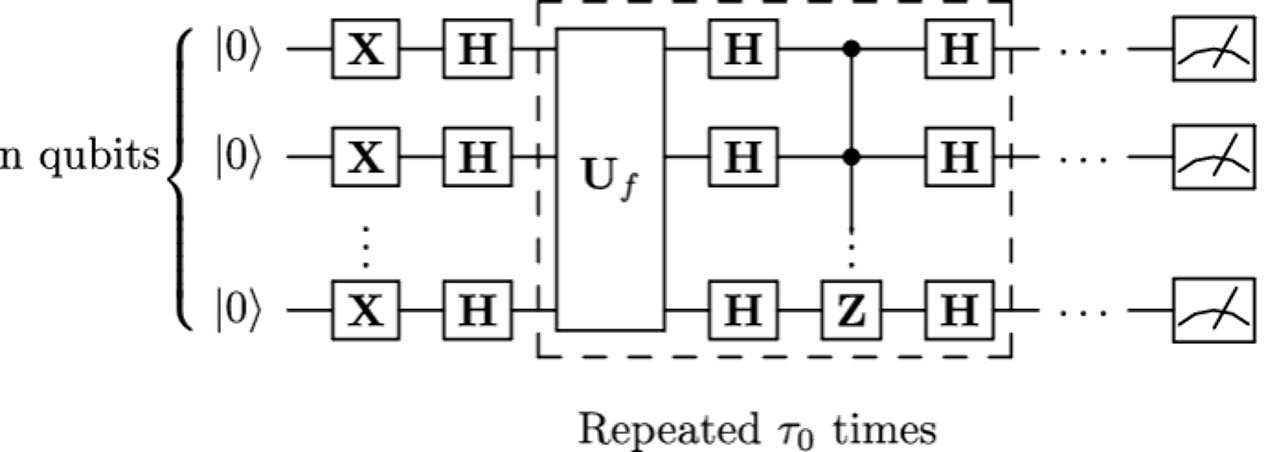
While Grover's search algorithm is asymptotically optimal, it does not always result in a real solution. If the search fails, the algorithm must be ran again from the beginning, conditionally doubling the effective number of oracle calls. Previous research attempted to fix this issue by modifying the oracle or alternating between numerically optimized reflectors. In this paper, we present an optimal initial state and reflector that produce an exact search with Grover’s algorithm at the cost of at most one additional oracle call beyond the optimum, a cost which can be nullified if we know a non-solution. We do this without modifying the oracle, without changing the diffuser at each step and even without any numerical optimization procedure required.
See more...
Authors:
B.C. Ciobanu, L.P. Verzotti and P.G. Popescu
Nature Scientific Reports 14, 11714 (2024)
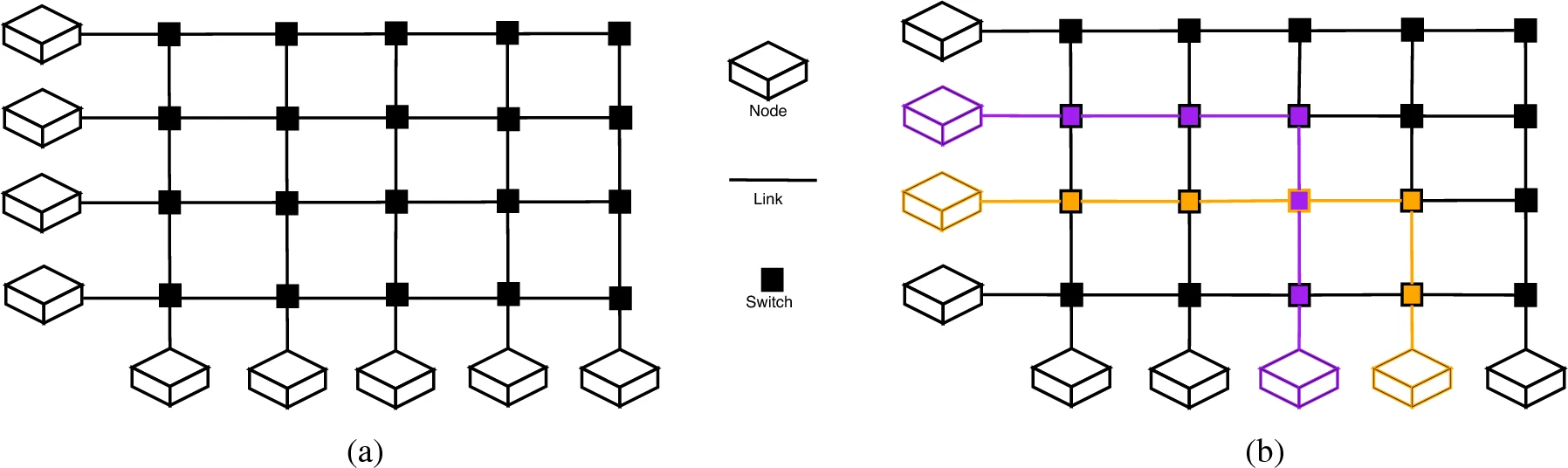
Crossbar networks are a cornerstone of network architectures, capable of operating both as standalone interconnections or as integral switching components in complex, multi-stage systems. The main advantages of crossbar networks are their non-blocking operation and unparalleled minimal latency. With the advent of large scale quantum networks, crossbars might be an important asset towards the Quantum Internet. This study proposes a solution for the problem of distributing entanglement within crossbar quantum networks. Entangled particles are a consumable resource in quantum networks, and are being used by most quantum protocols. By ensuring that nodes within quantum networks are being supplied with entanglement, the reliability and efficiency of the network is maintained. By providing an efficient, scalable framework that can be used to achieve optimal entanglement distribution within crossbar quantum networks, this study offers a theoretical achievement which can be also used for enhancing quantum network performance. An algorithm for selecting an optimal entanglement distribution configuration is proposed and fully tested on realistic possible configurations.
See more...
Authors:
A.B. Popa and P.G. Popescu
Nature Scientific Reports 14, 13977 (2024)
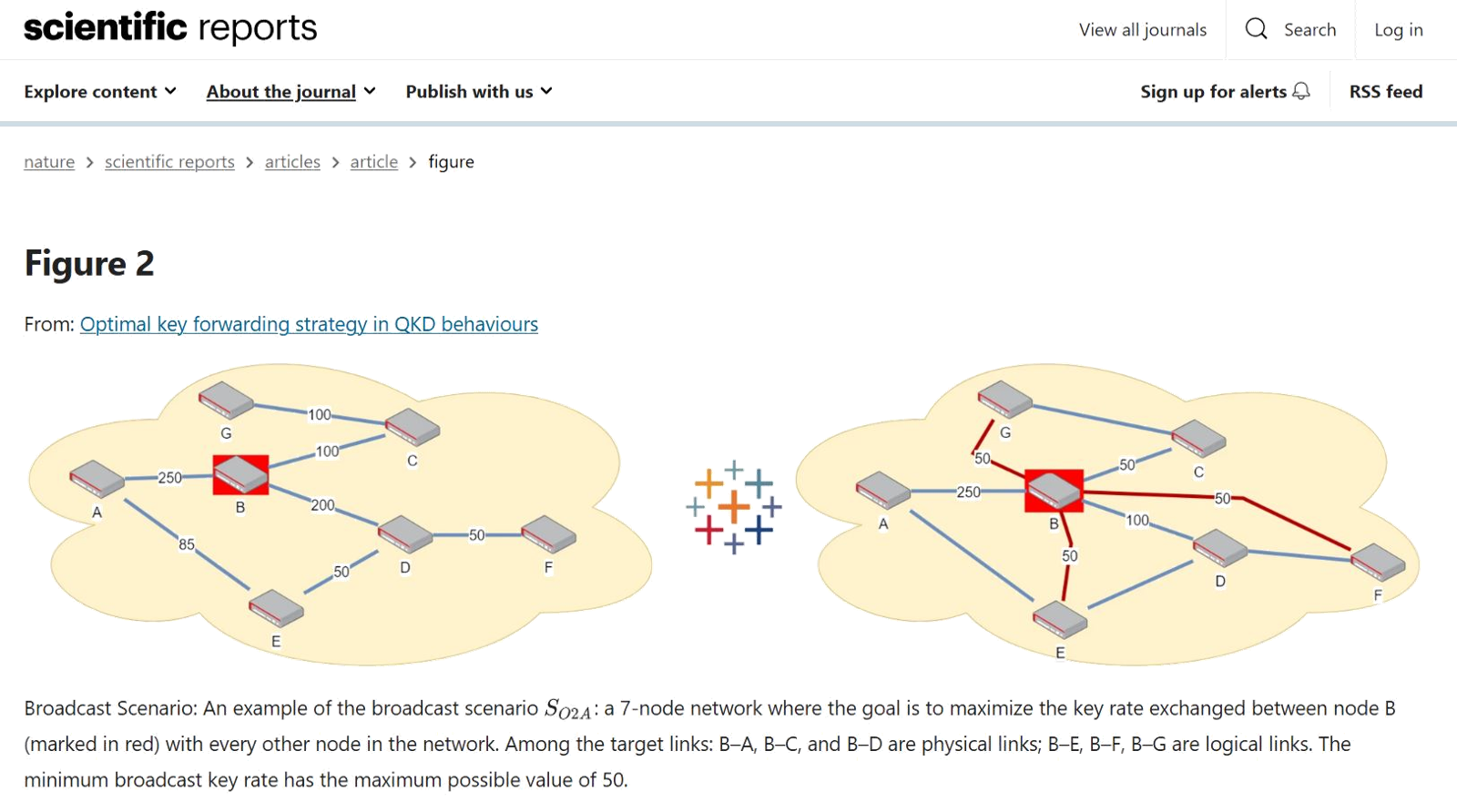
Nowadays QKD plays a critical role in unconditionally-secure and quantum-safe key distribution. Commercially available QKD devices are getting more popular for institutional and governmental national and international networks, but are expensive and offer limited key rates. We provide a formalization of QKD-generated key forwarding and redistribution at the KMS level by extending the network graph of physical QKD links to the complete graph with logical links, and we investigate its application on three practical scalable scenarios (all-to-all, one-to-all, one-to-one). We define a maximization goal for each scenario, and provide a linear programming problem statement to compute the optimal redistribution. We perform an extensive analysis of the algorithm in terms of forwarding results and key consumption on simulated QKD networks and discuss the implications of network size and graph topology on the algorithm’s performance and complexity.
See more...

Authors:
L. Perju Verzotti , B.C. Ciobanu and P.G. Popescu
Nature Scientific Reports 13, 9834 (2023)
This study clarifies the problem of decongestion in quantum networks, with a specific focus on the crucial task of entanglement distribution. Entangled particles are a valuable resource in quantum networks, as they are used for most quantum protocols. As such, ensuring that nodes in quantum networks are supplied with entanglement efficiently is mandatory. Many times, parts of a quantum network are contested by multiple entanglement resupply processes and the distribution of entanglement becomes a challenge. The most common network intersection topology, the star-shape and it's various generalizations, are analyzed, and effective decongestion strategies, in order to achieve optimal entanglement distribution, are proposed. The analysis is comprehensive and relies on rigorous mathematical calculations which aids in selecting the most appropriate strategy for different scenarios optimally.
See more...

Authors:
A. Tănăsescu, D. Constantinescu and P.G. Popescu
Nature Scientific Reports 12, 21310 (2022)
Factoring a 2048-bit number using Shor's algorithm, when accounting for error correction, reportedly requires 400,000 qubits. However, it is well known that there is yet much time before we will have this many qubits in the same local system. This is why we propose a protocol for distributed quantum computation applicable to small register devices, specifcally for the distribution of controlled unitary gates, the key element in the construction of every quantum computation algorithm. We leverage quantum sharing of partial results to obtain a parallel processing scheme, allowing for the frst time the quantum distribution of very large gates with thousands of inputs using only small register devices with tens of qubits. In this way, we improve all previous controlled unitary gate distribution approaches, obtaining surprising results. The impact is quantifed for recent milestone hardware realizations of quantum processors.
See more...

Authors:
B.C. Ciobanu, V. Iancu and P.G. Popescu
IEEE Access 10, 69963-69971 (2022)
In the practical context of quantum networks, quantum teleportation plays a key role in transmitting quantum information. In the process of teleportation, a maximally entangled pair is consumed. Through this paper, an efficient scheme of re-establishing entanglement between different nodes in a quantum network is explored. A hybrid land-satellite network is considered, where the land-based links are used for short-range communication, and the satellite links are used for transmissions between distant nodes. This new scheme explores many different possibilities of resupplying the land nodes with entangled pairs, depending on: the position of the satellites, the number of pairs available and the distance between the nodes themselves. As to make the entire process as efficient as possible, we consider the situations of direct transmissions of entangled photons and also the transmissions making use of entanglement swapping. An analysis is presented for concrete scenarios, sustained by numerical data.
See more...

Authors:
A. Tănăsescu, A. Balan, and P.G. Popescu
The European Physical Journal Plus 136, 476 (2021)
In this paper, we find the minimal number of correlation tests required to certify independence of two classical random variables of arbitrary finite support. Moreover, we completely characterize the constraints implied by zero correlations upon an arbitrary heterogeneous quantum state, and we solve the conjecture proposed by Ohira in 2020. Finally, we find the first ever algorithm for computing (or checking) the Schmidt rank of any unknown pure quantum state using only zero-correlation tests, finding a sufficient amount of tests certifying separability or full entanglement.
See more...

Authors:
A. Tănăsescu, and P.G. Popescu
Quantum Information Processing 20 (2), 1-17 (2021)
As heterogeneous quantum systems become a high-impact topic in the state of the art through hybrid entanglement, none of the many competing measures of multipartite entanglement has yet been shown to provide a complete characterization. In this paper, for the first time, we connect two of the most popular research directions on entanglement of heterogeneous systems: correlation tensors on the one hand, and concurrence and tangle on the other. We find the first ever separability criteria for heterogeneous quantum systems under any arbitrary partition in terms of multipartite concurrence and tangle, respectively, generalizing and refining previous work on m-separability of homogeneous systems, and we derive the first relations between the Frobenius norms of correlation tensors, concurrence and tangle, generalizing previous work for homogeneous systems.
See more...

Authors:
A. Tănăsescu, V.-F. Iliescu, and P.G. Popescu
Physical Review A 101 (4), 042309 (2020)
Entanglement-assisted random access codes (EARACs) compress a large amount of bits, such that any chosen one of them can be recovered with a large probability of success. They have been used for information theoretic treatments of semi-device-independent randomness certification and other communication complexity problems. For high-dimensional problems, the access request distribution can be used to obtain better performance, which until now could only be achieved through numerical methods. This paper makes an analytical account of access request distribution for arbitrary input sizes. We introduce entanglement-assisted almost-random access codes (EAARACs), which maximize the average probability of access under an arbitrary distribution of requests, thus refining EARACs and generalizing the methods used in the study of low-dimensional communication complexity problems. We analytically find the optimal probability of success for EAARACs under arbitrary request distributions and provide an illustrative numerical example.
See more...
Authors:
A. Tănăsescu, and P.G. Popescu
Quantum Information Processing 19 (6), 1-15 (2020)
Refining recent results, we propose an upper bound for the norms of Bloch Vectors for heterogeneous quantum systems containing an arbitrary number of qudits with possibly different numbers of levels. We also generalize recent approaches for tripartite and four-partite heterogeneous systems and for multipartite homogeneous systems. Our results imply a necessary algebraic condition for separability of a general multipartite heterogeneous quantum system under arbitrary partitioning.
See more...

Authors:
P.G. Popescu and O. Stănășilă
Politehnica Press, ISBN 978-606-515-885-6 (2019)
Baza matematică a calculului cuantic o constituie Algebra Lineară adaptată, Matematică discretă și Statistica, mai putin Analiza functională si Geometria.
În Capitolul 1 vom prezenta noțiunile de bază ale calculului cuantic, începând cu qubiții, exemple fizice convingătoare și un curs scurt de Algebră Lineară, unde amintim formalismul <bra|ket >al lui Dirac, clase esențiale de matrice (hermitice, unitare), descompunerea spectrală ș.a..
Apoi, produsele tensoriale și qubiții multipli sunt legate de registrele cuantice.
În Capitolul 2 reamintim formalismul automatelor (deterministe, probabiliste, cuantice) și prezentăm un alt curs scurt, de axiomatică a M.C., fără a presupune cunoștinte adânci de Fizică cuantică.
Capitolul 3 se referă la porțile logice (clasice și cuantice) și la circuitele cuantice, adaugând câteva aplicații semnificative privind nonclonarea, teleportarea, codarea densă.
Ultimul capitol este dedicat Algoritmilor cuantici, un subiect spectaculos care, în ultimii 30 de ani, a canalizat interesul multor specialisti: ingineri, ITști, fizicieni, matematicieni, medici, economiști, militari, în dezvoltarea unui domeniu de mare însemnătate și sperantă.
Totodată, vom schița conceptul de masină Turing cuantică, implementarea algoritmilor cuantici, precum și chestiuni legate de complexitatea calculelor.
See more...

Authors:
A. Tănăsescu, and P.G. Popescu
EPL (Europhysics Letters) 126 (6), 60003 (2019)
In this letter, we find an upper bound for the norms of Bloch vectors for quantum systems comprised of an arbitrary number of qudits. We generalize a recent result of Li et al. for four-partite quantum systems. We apply our result to provide an upper bound on the entanglement measure given by the Bloch vector norm and we provide a necessary algebraic condition for separability of a general multi-partite quantum system under any arbitrary partition function. Finally we show that the finer the partitioning is, the smaller our upper bound becomes.
See more...

Authors:
A. Tănăsescu, M.-Z. Mina, and P.G. Popescu
Physics Letters A 383 (18), 2168-2171 (2019)
Non-local implementations of quantum gates are a vital part of quantum networks. We find an optimal non-local implementation of quantum functions, the quantum gate equivalent of a switch statement. Then, we apply this result to the Deutsch-Jozsa problem, obtaining a distributed Deutsch-Jozsa algorithm and we show the relative efficiency improvement. As an application, we find a non-cooperative game based upon the original Deutsch-Jozsa problem where a classical agent has at most a 50% probability of winning, while a quantum agent can win every time.
See more...

Authors:
M.-Z. Mina, and P.G. Popescu
Applied Sciences 8 (10), 1935 (2018)
In the practical context of quantum networks, the most reliable method of transmitting quantum information is via teleportation because quantum states are highly sensitive. However, teleportation consumes a shared maximally entangled state. Two parties Alice and Bob located at separate nodes that wish to reestablish their shared entanglement will not send entangled qubits directly to achieve this goal, but rather employ a more efficient mechanism that ensures minimal time resources. In this paper, we present a quantum routing scheme that exploits entanglement swapping to reestablish consumed entanglement. It improves and generalizes previous work on the subject and reduces the entanglement distribution time by a factor of 4k in an arbitrary scale quantum network, where N=4k−1 is a required number of quantum nodes located between source and destination. In addition, k is the greatest positive integer considered by Alice or Bob, such that afterwards they choose N quantum switches.
See more...